
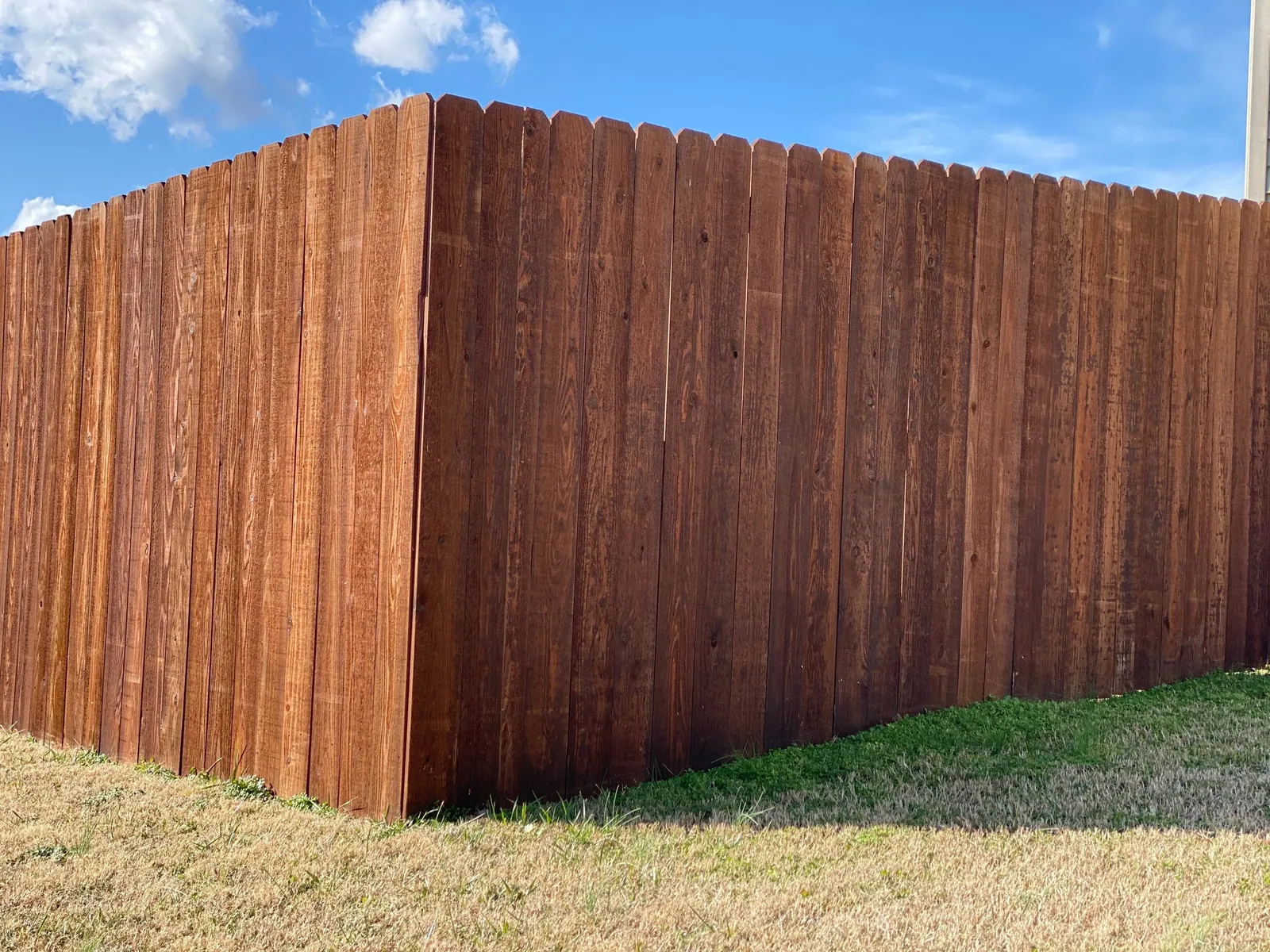
Solid vs Semi-Transparent Stain: Which One Fits Your Fence or Deck?
Semi-transparent stain lets the wood grain show through, and it mostly fades as it wears. Solid stain covers the grain like paint, and it can peel as it wears. The guides quoted below give solid stain a longer stretch between coats. Semi-transparent stain keeps the look of real wood.
So the wood itself decides most of it. New wood, or wood still in good shape, suits a see-through stain. Weathered or patched boards are where solid stain usually gets picked, for the cover. The USDA Forest Products Laboratory is more cautious: its stain report says solid stains can be used successfully on siding but should not be used on structures such as decks and fences, and its deck guide recommends penetrating finishes, a group that includes semi-transparent stain.
Every fence staining job we do around San Antonio starts with a wash and a full dry-out. The right look is easier to judge at a free estimate, with the boards in front of you.
What is the difference between solid and semi-transparent stain?
The difference is how much pigment sits on the wood. More pigment covers more of the board.
Semi-transparent stain is thin. A painting contractor’s guide says it lets the grain and texture of the wood show through. The Forest Products Laboratory says much of the grain shows, and no film forms unless too many coats go on.
Solid stain is thicker. The same painting contractor’s guide calls it more paint-like. It covers the surface and masks the grain. A paint store’s guide notes it is still thinner than paint, and the texture of the boards still shows.
| Semi-transparent stain | Solid stain | |
|---|---|---|
| Wood grain | Shows through | Covered, like paint |
| How it wears | Oil-based fades, water-based tends to peel (painting contractor’s guide) | Can peel over time (stain maker’s guide) |
| On a deck | Starts to fail at 1 to 3 years (painting contractor’s guide) | 2 to 4 years before it starts to peel (same guide) |
| On a fence | Restain every 2 to 3 years (Austin fence company’s guide) | Up to 5 years (same guide) |
| Best fit | New or slightly weathered wood (stain maker’s guide) | Heavily weathered wood or patched sections (same guide) |
| USDA lab’s view | Penetrating finishes recommended for deck floors | Should not be used on decks and fences (1999 stain report) |
| Changing your mind | More pigment can go on later | Going back means removing the coating first |
These are guide numbers from the sources named, not a promise for any fence or deck.
How does each stain wear over time?
Semi-transparent stain mostly wears by fading. A painting contractor’s guide says oil-based versions fade, while water-based versions tend to peel. The Forest Products Laboratory says penetrating semi-transparent stains form no continuous layer, so they do not blister or peel. It adds that the wood does not need scraping before the next coat.
Solid stain wears more like paint. A stain maker’s guide says solid stains hide the grain and can peel over time if not maintained. The lab’s deck guide says film-forming finishes, solid stain among them, tend to trap moisture and fail by peeling.
How often does each stain need a new coat?
For decks, a painting contractor’s guide says solid stain typically lasts 2 to 4 years before it starts to peel. The same guide says semi-transparent stain starts to fail anywhere from 1 to 3 years in.
For fences, an Austin fence company’s guide budgets restaining every 2 to 3 years with semi-transparent stain. With solid stain, that guide says up to 5 years. A paint store’s guide ranks solid stain ahead of semi-transparent on performance, with solid needing maintenance least often.
The paint store’s guide calls vertical surfaces like fences the least demanding place for a stain. It calls horizontal surfaces like decking the most demanding. The painting contractor’s guide names sun exposure and foot traffic as factors in a deck stain’s life.
Can you switch from solid stain back to semi-transparent?
Not easily. Stain works like a one-way street.
Each new coat adds pigment. A paint store’s guide says maintenance coats keep darkening the surface and slowly cover up more of the wood. Moving toward a darker or more solid look is the easy direction.
Going back is the hard part. The Forest Products Laboratory says a penetrating stain cannot go over a film-forming finish unless that finish comes off completely. A stain maker’s guide gives the same advice about solid stain. If you love the grain, think it over before a fence goes solid.
Which stain suits new wood, and which suits weathered or patched wood?
Wood in good shape is where semi-transparent stain makes the most sense. A stain maker’s guide says it works on both new and slightly weathered surfaces.
Weathered and patched boards are a different story. The same stain maker’s guide says solid stain is used on heavily weathered wood, patched sections and mismatched boards. A painting contractor’s guide says solid stain does a good job covering imperfections such as cracks and blemishes.
Patched fences show why. The stain maker’s guide notes that newer and older wood can absorb stain differently. Under a see-through stain, that difference in color can show.
The Forest Products Laboratory adds a caution. Its stain report says solid stains should not be used on structures such as decks and fences, and that the weathered surface must be removed before a solid stain goes over weathered wood. Cover is what solid stain offers a tired fence; the lab’s guidance is the other side of that trade.
Which stain is better for a wood deck?
A deck floor takes foot traffic, and that changes the answer. The Forest Products Laboratory’s deck finish guide says penetrating finishes, not film-forming finishes, should be used on wood decks. It lists semi-transparent stains among the penetrating finishes.
The guide’s reason is wear. It says film-forming finishes get excessive wear, especially in high-traffic areas. For railings, the same guide says solid stain may perform quite well.
Our deck staining work covers wood deck boards, stairs and railings. Composite boards are a separate case: we clean them and never stain them.
What do San Antonio sun and heat mean for the choice?
Climate normals put San Antonio at an average of 122 days a year at 90 degrees or hotter. Eighteen of those days reach 100 degrees or more.
A paint store’s guide calls the sun’s UV rays and moisture the two biggest enemies of an exterior finish. The more exposure a finish gets, the guide says, the shorter its life.
Pigment is what stands up to the sun. The Forest Products Laboratory says pigment protects the wood surface from sunlight and greatly increases how long a stain lasts. A stain maker’s guide says darker stain colors give more UV protection.
The same stain maker’s guide says areas with more direct UV exposure may fade faster. Shaded areas hold their color longer. More pigment buys more sun protection and shows less grain.
What does the wood need before either stain goes on?
Either stain needs clean, dry wood. The Forest Products Laboratory says mildew should be removed from wood before it is stained. Its deck guide says to allow at least 2 warm, windy days for a deck to dry after cleaning.
That is why our stain jobs start with deck and fence cleaning. The wash takes off the gray layer and any green or black growth. Then the wood dries all the way through before any stain goes on.
How do you choose for your fence?
Start with the look you want and the shape the wood is in. Sound boards with grain you like point one way. Gray or patched boards point the other. Pigment is easy to add and hard to take back.
We are based in San Antonio and stain wood fences and decks across the San Antonio to Austin corridor. Estimates for our fence staining service are free, with financing on larger projects. For price ranges, see our fence staining cost guide and deck staining cost guide. Call or text (512) 905-8038 to set up a visit.